

Why investors increasingly expect institutional-grade analytics in private investing
Public-market investors have had real-time prices, benchmarks, and screens on their desks for decades.
Private-market investors have had quarterly statements, PDFs, and spreadsheets.
That gap was tolerable when private markets belonged to a few hundred institutions.
It is much harder to defend as they open to advisors, family offices, and individual investors.
But the next phase may look very different from the last.
Data providers are paying billions to own the dataset.
Benchmarks are moving onto the screens investors already use.
Valuations are moving from quarterly toward daily.
Regulators are widening access, and asking managers to show their work.
And AI is putting all of it inside the advisor’s workflow.
Welcome to Building the Bloomberg Terminal for Private Markets.
The Information Gap
Private markets have grown up. Their information infrastructure hasn’t kept pace.
In an October 28 report, McKinsey expects private assets to nearly double from about $16 trillion to about $27 trillion by 2029, and estimates about 20% of private-market AUM is now raised from individuals, up from 4% in 2020.
Yet as the Private Markets newsletter observed on October 30, “no definitive list of individual fund returns exists,” and private markets “still have no equivalent of the S&P 500 or the Bloomberg Terminal.”
Capital is arriving faster than the tools to evaluate it.
Wall Street Is Buying the Dataset
The largest data companies have noticed.
On October 22, LSEG agreed to acquire Octus, a credit intelligence and data provider, for $3.535 billion in cash, saying the deal “will transform LSEG’s presence in credit and private market data.”
LSEG sizes the private-markets data, workflow, and access segment at $7 to $9 billion today, growing at a double-digit rate.
The firms that built public-market data infrastructure now see private-market data as their next growth engine.
Benchmarks Move Onto the Desktop
Data only becomes intelligence when it can be compared.
On October 27, LSEG made its expanded private-markets offering generally available in Workspace, combining Preqin and Nasdaq eVestment data for fund screening, peer-group analysis, and benchmarking.
“Investors need more than a fund’s headline returns,” LSEG’s Jenn Giacobbe said. “They need to understand how it compares with relevant peers and the wider market.”
The same day, MSCI Inc. made private-markets benchmarking using IRR, TVPI, DPI, and other measures available through its connector for Claude for Financial Advisors.
Benchmarking is no longer a consultant’s annual project.
It’s becoming a query.
Valuations Move From Quarterly to Daily
The biggest gap has always been price.
Apollo has extended Daily Pricing across its $850 billion credit business, with asset-level pricing for applicable funds slated to begin October 30. Apollo is careful to say Daily Pricing is an estimated fair value, “not a market-clearing price.”
“The industry has some work to do on standardizing guidelines around valuation in some of these vehicles that are ... evergreen or semi-liquid,” Morgan Stanley Investment Management’s Ben Huneke said, FundFire reported.
More frequent marks are only as good as the data beneath them.
A daily number built on stale inputs is still a stale number.
Regulators Open the Door and Ask to See the Work
Regulators are widening access and raising the bar for transparency at once.
In October 27 remarks to the SEC’s Small Business Capital Formation Advisory Committee, Chairman Paul Atkins called “expanding investor access to private markets - while maintaining fraud prevention measures” one of his top priorities. He pointed to the Commission’s September notices of potential new ways to qualify as an accredited investor, including “by passing an exam to be developed by the Financial Industry Regulatory Authority,” and said he has asked staff to evaluate how Regulation Crowdfunding can be amended “to reduce compliance burdens.”
On October 23, the SEC’s Division of Examinations named retail investor protection in “complex, higher-risk, and illiquid products,” along with private funds and private credit, among its fiscal 2027 priorities.
A September 28 SEC staff statement on fair value went further, cautioning that “boilerplate” or overly aggregated disclosures may not give investors enough context, as DLA Piper summarized on October 30.
More investors means more scrutiny.
Valuation methodology is becoming part of the product.
The Advisor’s Desk Goes Institutional
The retail revolution runs through the advisor.
On October 28, Schwab made Claude for Financial Advisors available through Schwab Advisor Center, which serves more than 17,000 independent RIAs.
KPMG’s October 28 survey of 100 fund managers and distributors shows why tools matter: 41% believe the market underestimates the cost and operational burden of servicing a much larger investor base, and 52% name liquidity design and redemption management as a top barrier to scaling evergreen products.
That investor base will expect institutional-grade answers.
From Analytics to Action
Analytics alone don’t move capital. They need rails.
On October 28, DTCC’s Tokenization Service went live, with 20 participants signed, connecting tokenized securities to the infrastructure behind more than $114 trillion in assets under custody.
The real opportunity is a connected lifecycle:
Data → Benchmarking → Valuation → Disclosure → Distribution → Subscription → Settlement → Liquidity
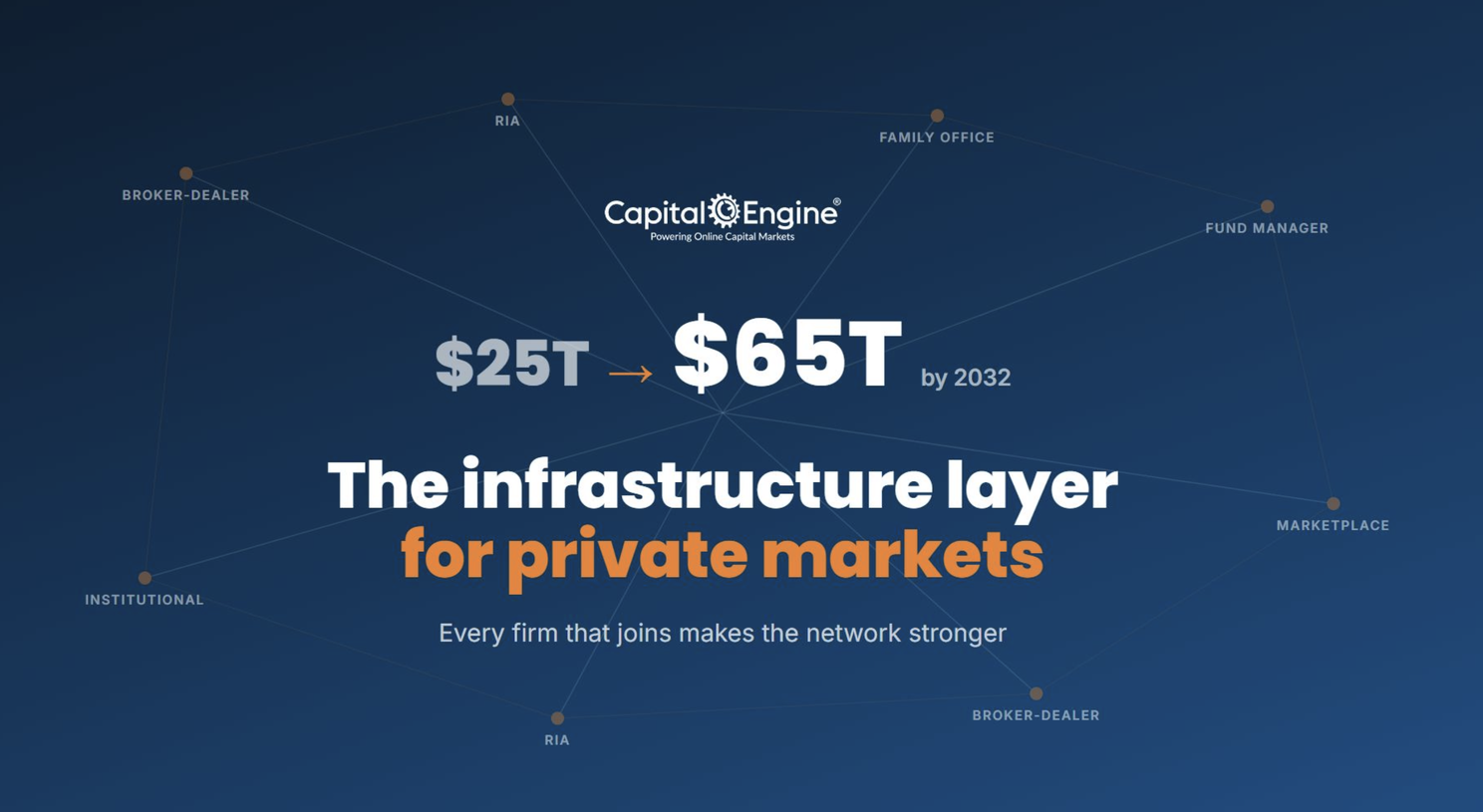
As private markets move from approximately $25 trillion toward a projected $65 trillion by 2032, the platforms that connect each step may define how investors experience the asset class.
Capital Engine®: Building the Data Layer
Capital Engine® is building the infrastructure layer for private markets, connecting issuers, broker-dealers, RIAs, family offices, and institutional investors through a single digital ecosystem.
Our infrastructure supports:
- Digital capital formation
- Investor onboarding
- KYC / AML and compliance workflows
- Reg D, Reg A+, and Reg S offerings
- White-label investment marketplaces
- Co-syndication and distribution
- AI-enhanced investor matching
- Investor management and reporting
- Tokenization and secondary-market infrastructure
Backed by our FINRA-approved acquisition of Mallory Capital Group ($10B+ raised), Glynn Capital Advisors (RIA) joining our firm, we’re building regulated connections between private-market opportunities and the investors and intermediaries who evaluate them.
As private investing becomes data-driven, we’re building the layer where offering data, investor data, and compliance data connect, so better information can lead to better decisions.
Building the Bloomberg Terminal for Private Markets
Public markets were transformed when information became standardized, comparable, and instantly accessible.
Private markets may be next, built around:
- Consolidated private-markets data
- Peer benchmarks inside everyday workflows
- More frequent, explainable valuations
- Clearer disclosure of methods and inputs
- AI-assisted analysis for advisors
- Connected settlement and liquidity rails
Better data won’t remove the risks of illiquid investing, and it won’t replace due diligence or suitability.
But it can make those risks easier to see, compare, and explain.
The opportunity isn’t simply to give more investors access. It’s to give them the information to use it well.
The next great private-markets platform may not be a marketplace or a terminal. It may be both.
EXPLORE PRIVATE MARKET INVESTMENTS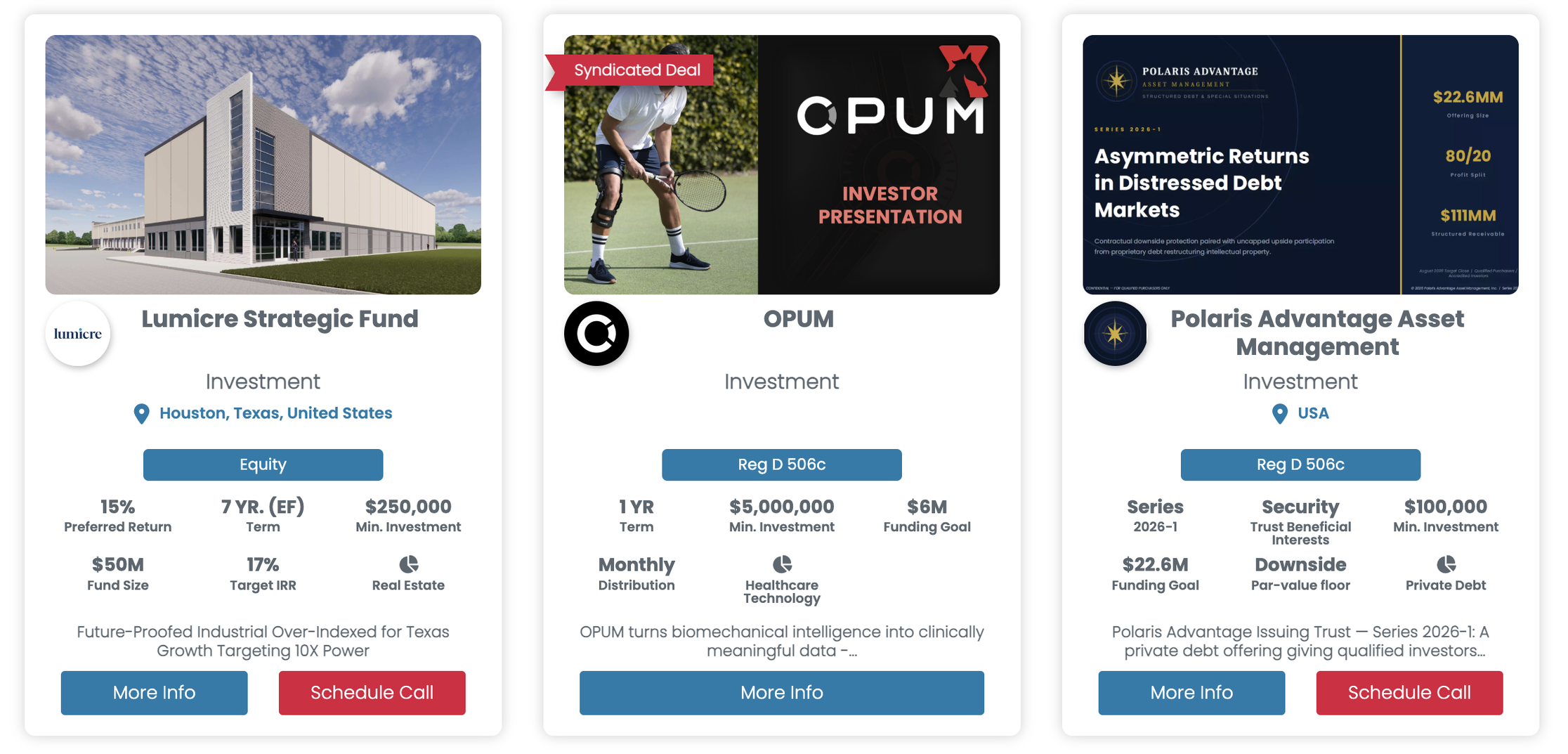
Private Markets This Month
Launch of StreetZero.com the AI Engine for Private Markets Intelligence. StreetZero tracks venture and private-placement deals — with AI analysis, source documents, and the proprietary StreetZero Signal REGISTER NOW
DTCC Tokenization Service Goes Live, Marking Major Milestone in the Adoption of Digital Assets DTC launched its tokenization service with 20 participants signed, including Morgan Stanley, J.P. Morgan, and Fidelity Investments. READ MORE
LSEG Expands Private Markets Research and Benchmarking in Workspace Combined Preqin and Nasdaq eVestment data now powers fund screening, manager evaluation, and private-versus-public benchmarking. READ MORE
KPMG: Private Markets Race to Scale as Investor Demand Broadens A global survey of 100 fund managers and distributors finds 69% expect meaningfully broader adoption within three years, with liquidity design the top barrier. READ MORE
SEC Chairman Atkins: Remarks at the Small Business Capital Formation Advisory Committee Meeting Chairman Atkins highlights potential new paths to accredited investor status, including a FINRA-developed exam, plus IPO communication reform and a review of Regulation Crowdfunding. READ MORE
In the Engine Room Podcast
Up Next: Private Markets Go Mobile Why the smartphone will become the primary gateway to private investing. If you missed any of the earlier issues, you can catch up at: Capitalengine.io/newsletter
Interested in learning more about Capital Engine® - Request a Demo
Subscribe on LinkedIn to the Private Capital Pulse newsletter to stay ahead of the curve in the evolving world of private investments.
T&C* Apply. Read our terms & privacy policy.