

How technology is replacing traditional fundraising models.
For decades, private-market fundraising ran on a familiar playbook.
Roadshows. Placement agents. Ten-year closed-end funds sold to a few hundred institutions.
Capital was raised one relationship, and one fund cycle, at a time.
That playbook is under pressure.
But the next phase may look very different from the last.
Wealth platforms are becoming primary markets.
Funds are being redesigned around how investors actually buy.
Retirement plans and consumer apps are embedding private-market access.
And AI is moving into the fundraising workflow itself.
Welcome to The New Distribution Economy.
The Old Fundraising Model Is Straining
The institutional model still works. It just works for fewer managers.
Ocorian’s Global Asset Monitor, a survey of 300 senior private equity executives published October 21, found that 62% say raising capital has become harder than in 2025, citing heavier due diligence, regulatory uncertainty, and LP overallocation.
Goldman Sachs Alternatives’ LP survey, released October 22, points to a root cause: lack of distributions is the top constraint on deployment plans, cited by 35% of 225 LPs.
When cash doesn’t come back, the next commitment gets harder to make.
Ocorian’s conclusion: managers have “a strong incentive to cast the fundraising net more widely rather than fish in the same institutional pool.”
The Wealth Channel Becomes a Primary Market
Look at where the growth is.
On October 22, Blackstone reported a record $330 billion of private wealth AUM, up 15% year over year, with nearly $9 billion of sales in the quarter.
“The opportunity in private wealth continues to expand for the firm,” said President Jon Gray.
New entrants are following. On October 20, Sagard took its private credit platform into the U.S. wealth market, building on its distribution partnership with Baird and leading with advisor education.
For years, wealth was treated as a secondary channel.
Increasingly, it’s where funds are designed to be sold.
Funds Are Being Rebuilt for Distribution
Product design is following the buyer.
In Ocorian’s survey, only 10% expect closed-ended drawdown vehicles to lead new fund launches over the next two years. Hybrid or perpetual structures with gates (63%) and evergreen funds (56%) top the list.
McKinsey’s Alexander Edlich notes that semiliquid structures have doubled since 2023 to more than $204 billion.
Ocorian frames the logic well: liquidity “helps make private-market products workable for investors who have historically struggled with a typical ten-year lock-up.”
But semi-liquid is not liquid.
Gates, repurchase limits, and redemption queues remain part of the design, and investors need to understand them before they invest.
Distribution Gets Embedded
The next shift is where private markets show up.
On October 21, Carlyle and Basic Capital announced that Carlyle private-market strategies, through SEI collective investment trusts, will be available on Basic Capital’s open-architecture 401(k) platform. The first solution is designed to sit inside a participant’s existing large-cap equity allocation.
In Europe, Revolut, with more than 75 million users, began offering eligible clients funds from Apollo, Ares, Hamilton Lane, and Partners Group in July, with minimums from €1, Bloomberg reported.
Private markets are no longer only a destination investors travel to.
They are being embedded where investors already are: the retirement plan, the brokerage app, the advisor’s dashboard.
AI Enters the Fundraising Workflow
More investors mean more relationships. That doesn’t scale on spreadsheets.
On October 20, Altvia launched Investor Engagement Manager, an AI-native tool that tracks LP relationships across every fund, flags drift, and drafts next steps, “human-approved before anything consequential happens.” Altvia cites the wealth channel arriving at scale as one reason.
Two days later, FinBursa launched an agentic front office whose agents can suggest investors suited to a deal and draft outreach. Nothing is sent without human approval.
AI won’t replace the trust that closes a commitment.
But it can help a lean team serve thousands of investors the way a large IR department once served hundreds.
Data Becomes the New Shelf Space
Distribution at scale requires comparability.
On October 20, FLX Networks and Blue Vault partnered to bring standardized alternatives data, covering approximately $750 billion in assets, into an analytics platform used by asset managers and wealth firms.
Demand from sophisticated private investors keeps building. Bank of America’s 2026 Family Office Study found that 59% of U.S. family offices plan to increase private equity exposure over the next one to three years.
The retail revolution and the great wealth transfer share one constraint.
Investors can’t allocate to what they can’t evaluate.
Liquidity Closes the Loop
A distribution economy also needs an exit ramp.
On October 21, Pantheon closed its latest global secondaries program at $6 billion, 71% above its $3.5 billion target, with significant commitments from new investors in Asia and the Middle East.
When distribution, servicing, and liquidity connect, the fund cycle starts to look like a continuous lifecycle:
Origination → Structuring → Distribution → Onboarding → Subscription → Servicing → Reporting → Liquidity
As private markets move from approximately $25 trillion toward a projected $65 trillion by 2032, much of that growth may depend on how efficiently each step connects.
Capital Engine®: Building the Distribution Layer
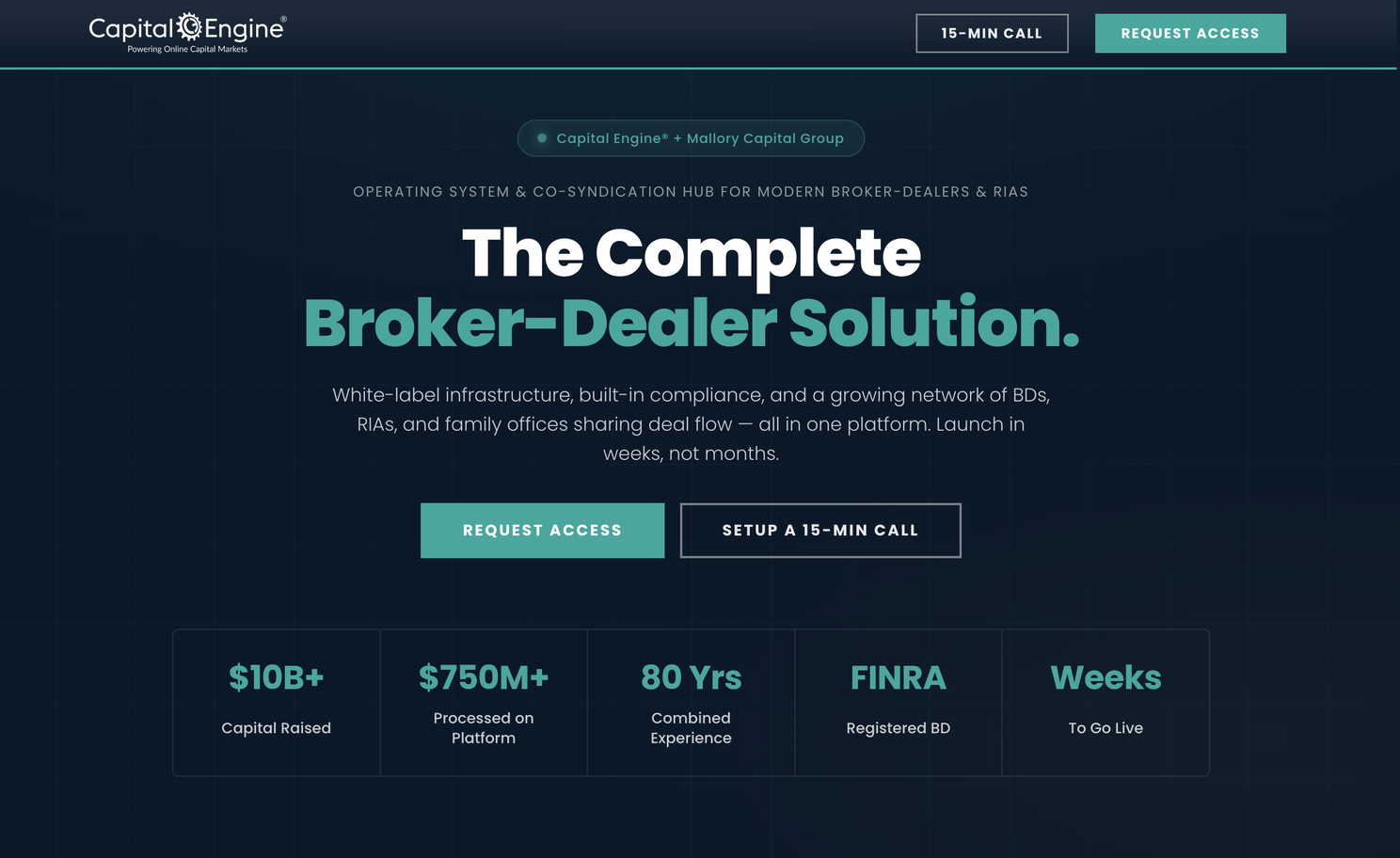
Capital Engine® is building the infrastructure layer for private markets, connecting issuers, broker-dealers, RIAs, family offices, and institutional investors through a single digital ecosystem.
Our infrastructure supports:
- Digital capital formation
- Investor onboarding
- KYC / AML and compliance workflows
- Reg D, Reg A+, and Reg S offerings
- White-label investment marketplaces
- Co-syndication and distribution
- AI-enhanced investor matching
- Investor management and reporting
- Tokenization and secondary-market infrastructure
Backed by our FINRA-approved acquisition of Mallory Capital Group ($10B+ raised), Glynn Capital Advisors (RIA) joining our firm, and our strategic alliance with multiple broker-dealers and RIAs, we’re building the regulated connections that help private-market opportunities reach eligible investors through the channels they already use.
As fundraising becomes distribution, we’re building the layer that connects private-market opportunities with the platforms, intermediaries, and investors where capital lives.
The New Distribution Economy
The first generation of private-market fundraising was built on roadshows, placement agents, and closed-end funds.
The next may be built around:
- Wealth platforms as primary markets
- Evergreen and semi-liquid structures
- Retirement plan and app-based access
- AI-assisted investor relations
- Standardized alternatives data
- Integrated secondary liquidity
Technology won’t eliminate relationships, due diligence, or suitability. It can help them scale.
The opportunity isn’t simply to raise more capital. It’s to rebuild how capital finds opportunity.
And as private markets move toward $65 trillion, the firms that master distribution may shape the decade ahead.
EXPLORE PRIVATE MARKET INVESTMENTS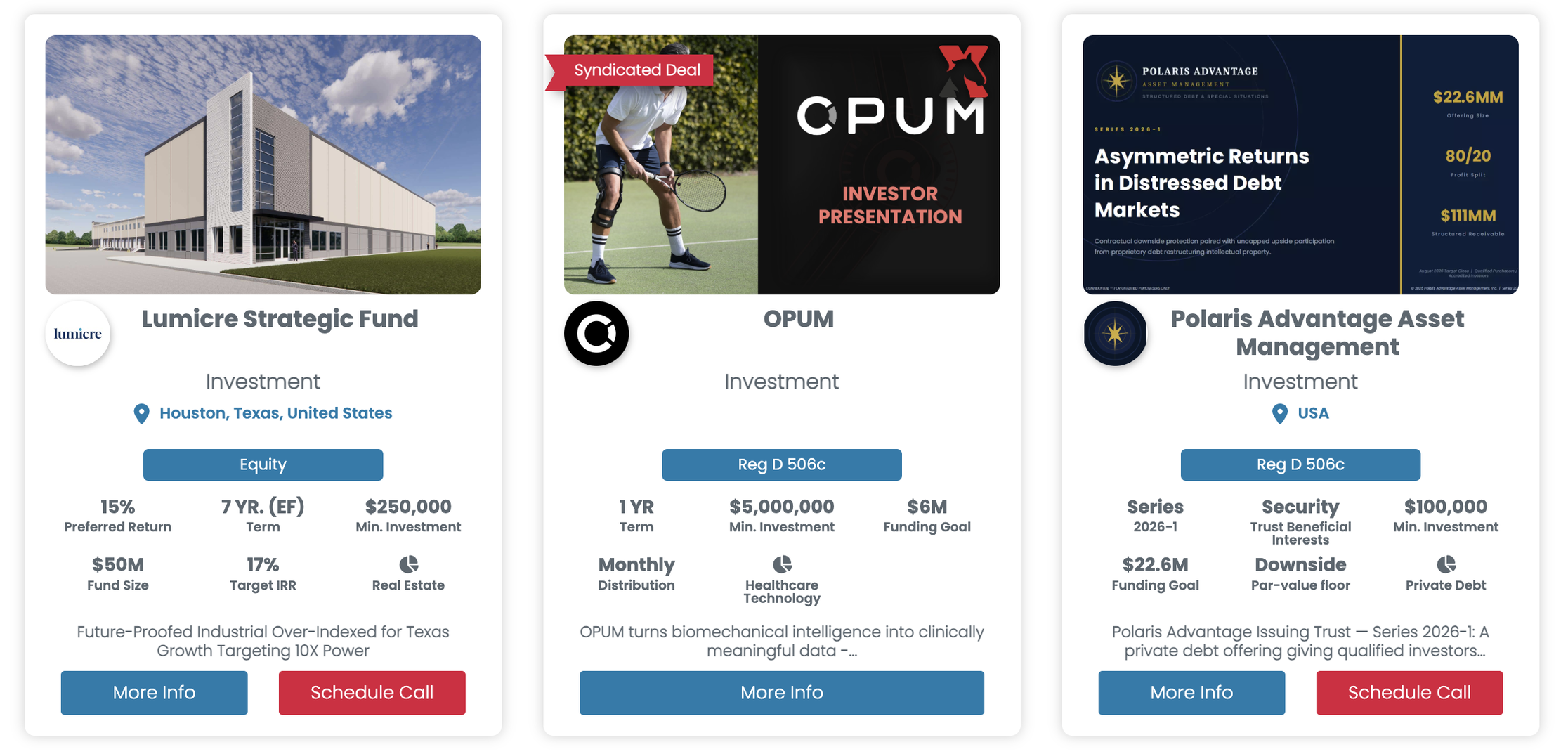
Private Markets This Month
Launch of StreetZero.com the AI Engine for Private Markets Intelligence. StreetZero tracks venture and private-placement deals — with AI analysis, source documents, and the proprietary StreetZero Signal REGISTER NOW
Blackstone Q3 Earnings: Private Wealth AUM Hits Record $330 Billion Blackstone’s individual-investor business grew 15% year over year, with nearly $9 billion of quarterly sales, even as exits slowed. READ MORE
Basic Capital and Carlyle Collaborate to Bring Private Markets Investing to 401(k) Plans Carlyle private-market strategies, through SEI collective investment trusts, are coming to Basic Capital’s open-architecture retirement platform. READ MORE
Goldman Sachs Alternatives Survey: “Rethinking, Not Retreating” A survey of 225 LPs finds most holding their private-markets pace, with lack of distributions the top constraint and secondaries increasingly used to manage liquidity. READ MORE
Pantheon Exceeds Target With $6bn for Its Latest Global Private Equity Secondaries Program Pantheon’s eighth flagship secondaries program closed 71% above target, with significant new commitments from Asia and the Middle East. READ MORE
In the Engine Room Podcast
Up Next: Building the Bloomberg Terminal for Private Markets Why investors increasingly expect institutional-grade analytics in private investing. If you missed any of the earlier issues, you can catch up at: Capitalengine.io/newsletter
Interested in learning more about Capital Engine® - Request a Demo
Subscribe on LinkedIn to the Private Capital Pulse newsletter to stay ahead of the curve in the evolving world of private investments.
T&C* Apply. Read our terms & privacy policy.