

The globalization of private markets through digital infrastructure.
Private markets have always been local.
Local relationships. Local regulation. Local investor networks.
A fund raised in New York was largely marketed in New York. A European deal was largely financed by Europe.
That map is now being redrawn.
But the next phase may look very different from the last.
Global managers are opening offices where the capital lives.
Fund passports are carrying private strategies across national lines.
Digital platforms are becoming the rails of distribution.
And tokenization is beginning to move settlement onto shared infrastructure.
Welcome to Capital Formation Without Borders.
Capital Is Following the Hubs
Wealth is increasingly global. It is also clustering.
According to BCG’s 2026 Global Wealth Report, cross-border wealth reached about $15.6 trillion in 2025, with the ten largest booking centers capturing almost 90% of new flows. For the first time, Hong Kong narrowly overtook Switzerland as the largest cross-border booking center, at $2.9 trillion. The UAE grew cross-border wealth 11.1% to $721 billion.
Boston Consulting Group (BCG) sees two hub networks forming: one anchored by Hong Kong and Singapore, another by Switzerland, the U.S., and the U.K.
For private-market issuers, that changes the question.
It’s no longer just which investors to reach. It’s which hubs, which structures, and which rules.
The Gulf Becomes a Destination
Nowhere is the shift more visible than Abu Dhabi.
On September 23, EQT Group launched a Middle East platform with its first office in ADGM, Abu Dhabi’s international financial center. Pantheon followed a week later, hiring a head of Middle East to lead capital formation. On October 2, Eurazeo opened its first Middle East office there, describing itself as a bridge between Gulf capital and European entrepreneurs.
The numbers behind the rush: ADGM reported 190 fund and asset managers at the end of the first half, up 23% year over year, with assets under management up 54%.
Distribution is following. In September, iCapital received its ADGM license and expanded Sharia-compliant alternative strategies for eligible Gulf investors.
The Gulf is no longer only a source of capital. It is becoming a place where capital is formed.
Europe Builds a Passport for Private Markets
Europe is tackling the same challenge through regulation.
ELTIF 2.0, the EU’s revised long-term investment fund framework, gives private strategies a passport to reach eligible investors across member states.
On September 29, LFDE and Titanbay launched an ELTIF 2.0 feeder open to professional and non-professional investors from €1,000, authorized in 11 European countries. Titanbay automates onboarding, KYC / AML, subscriptions, and reporting.
On October 6, Tikehau Capital made a European private credit ELTIF available through iCapital Marketplace to wealth managers across eligible EMEA markets.
And on October 8, Morgan Stanley Investment Management launched its Alternatives Investing Center in Europe to help advisers bring private markets into client portfolios.
Access. Distribution. Education.
All three are now crossing borders together.
Platforms Become the Rails
What connects these moves is infrastructure.
iCapital reports $1.2 trillion of assets serviced on its platform and 18 offices, from Zurich and Abu Dhabi to Hong Kong, Tokyo, and Toronto. In late September, DTCC, the post-trade backbone of U.S. markets, made a strategic investment in iCapital to help standardize private-market workflows.
DTCC’s Talia Klein named the gap: “Private markets have traditionally lacked the operational standards that exist in public markets.”
Cross-border capital formation needs every step to connect:
Issuer → Structuring → Eligibility → Onboarding → Distribution → Settlement → Reporting → Liquidity
Each border adds a regulator, a wrapper, and a data standard.
The platforms that absorb that complexity may define who can raise capital globally.
Tokenization Crosses Borders
Tokenization is moving from pilots into regulated, cross-border distribution.
On October 5, Fidelity International brought its tokenized U.S. dollar money market fund to professional and accredited investors in Singapore through Sygnum’s MAS-licensed platform. Sygnum Bank says tokenized liquidity now exceeds $15 billion.
On October 7, Assetera began offering Ondo Finance’s tokenized U.S. stocks and ETFs to eligible investors across all 30 EEA countries under its Austrian MiFID II license.
On October 8, Crédit Agricole Assurances made a €100 million initial investment in a tokenized Amundi money market fund, with CACEIS providing the infrastructure.
Most of today’s activity involves cash and listed securities, not private funds.
But the rails being built for one could increasingly carry the other.
America Widens the Front Door
The U.S. remains the deepest private market in the world, and its access rules are moving.
The SEC’s September 30 proposals were published in the Federal Register on October 5 and 6. Comments on the interval fund and multi-class proposal, and on the five accredited-investor notices, are due December 4. Comments on the performance-fee proposal are due December 7.
None of this is final.
But if adopted, these changes could widen who can invest in U.S. private-market vehicles, and how.
For U.S. issuers, the opportunity may run both ways: a broader domestic investor base, and non-U.S. investors reachable through frameworks such as Regulation S.
Capital formation is becoming a two-way street.
The $65 Trillion Market Has No Single Address
As private markets move from approximately $25 trillion toward a projected $65 trillion by 2032, much of that growth may come from investors far from traditional financial centers.
Sovereign funds in the Gulf. Family offices in Singapore. Savers in Europe. RIAs and wealth platforms in the U.S.
Each needs suitable access, local compliance, and reliable reporting. That requires infrastructure for:
- Multi-jurisdiction offerings
- Investor eligibility and KYC/AML
- Cross-border co-syndication
- Local wrappers and feeder structures
- Digital subscription and settlement
- Common reporting standards
- Secondary liquidity
The firms that solve fragmentation across borders may help unlock the largest pools of capital.
Capital Engine®: Building the Cross-Border Layer
Capital Engine® is building the infrastructure layer for private markets, connecting issuers, broker-dealers, RIAs, family offices, and institutional investors through a single digital ecosystem.
Our infrastructure supports:
- Digital capital formation
- Investor onboarding
- KYC / AML and compliance workflows
- Reg D, Reg A+, and Reg S offerings
- White-label investment marketplaces
- Co-syndication and distribution
- Investor management and reporting
- Secondary-market infrastructure
Backed by our FINRA-approved acquisition of Mallory Capital Group ($10B+ raised), Glynn Capital Advisors (RIA) joining our firm, and our strategic alliance with Regiment Securities, we’re building the connections that help private-market opportunities reach eligible investors, at home and abroad.
As capital formation goes global, we’re building the cross-border layer that helps capital move compliantly, wherever it lives.
Capital Formation Without Borders
The first generation of private markets was built on local relationships and local capital.
The next may be built around:
- Global financial hubs
- Passported fund structures
- Digital distribution platforms
- Tokenized settlement rails
- Broader investor eligibility
- Shared data standards
Borders won’t disappear. Regulation, suitability, and investor protection still matter, and they should.
The opportunity isn’t simply to sell private investments in more countries. It’s to build the infrastructure that lets capital move across them.
And as private markets move toward $65 trillion, capital formation without borders could become one of the defining forces of that transformation.
EXPLORE PRIVATE MARKET INVESTMENTS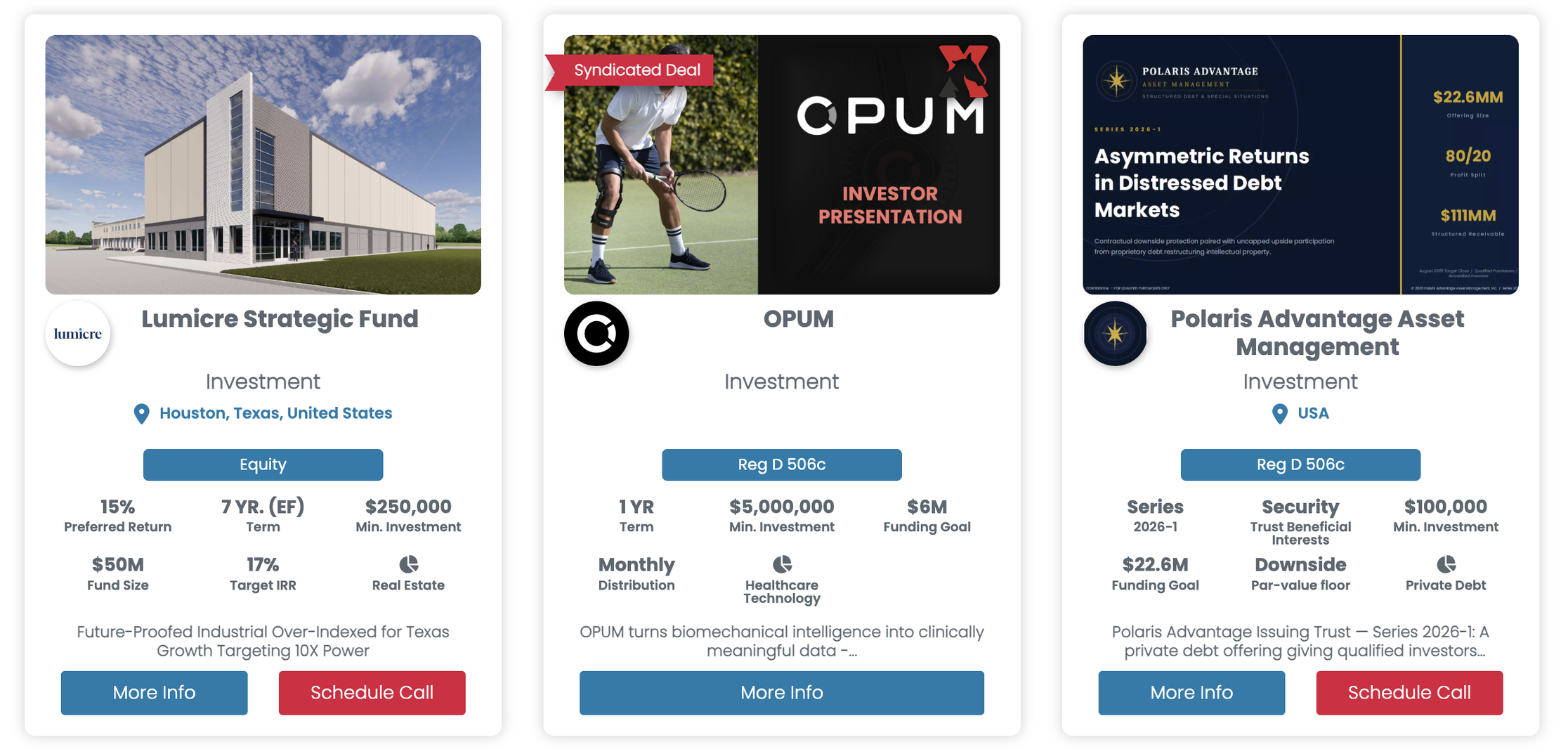
Private Markets This Month
Launch of StreetZero.com the AI Engine for Private Markets Intelligence. StreetZero tracks venture and private-placement deals — with AI analysis, source documents, and the proprietary StreetZero Signal REGISTER NOW
Tikehau Capital Expands European Private Credit Distribution Through iCapital® Marketplace A Luxembourg-domiciled evergreen ELTIF investing mainly in first-lien European corporate debt is now available to wealth managers across eligible EMEA markets. READ MORE
Morgan Stanley Investment Management Launches Alternatives Investing Center A new education platform aims to help European financial advisers incorporate private-market strategies into client portfolios. READ MORE
Fidelity International Partners Sygnum to Introduce Tokenised Liquidity to Singapore Fidelity’s tokenized U.S. dollar money market fund reaches Singapore’s professional and accredited investors through a MAS-licensed platform. READ MORE
Assetera Lists 450+ Ondo Tokenized Stocks and ETFs for Eligible Investors Across 30 EEA Countries A MiFID II-licensed platform separates token issuance from regulated distribution to bring tokenized U.S. equities to European investors. READ MORE
In the Engine Room Podcast
Up Next: Capital Formation Without Borders The globalization of private markets through digital infrastructure. If you missed any of the earlier issues, you can catch up at: Capitalengine.io/newsletter
Interested in learning more about Capital Engine® - Request a Demo
Subscribe on LinkedIn to the Private Capital Pulse newsletter to stay ahead of the curve in the evolving world of private investments.
T&C* Apply. Read our terms & privacy policy.