

Why the smartphone will become the primary gateway to private investing
Private investing used to start with a phone call, a paper subscription agreement, and a wire.
For many investors, it may soon start with a tap.
That shift is bigger than convenience.
It changes who can discover an opportunity, how they learn about it, and who stands between them and the investment.
But the next phase may look very different from the last.
Private-market apps are arriving.
Regulators are building the legal rails.
Wealth channels keep growing.
AI is becoming the concierge.
And tokenization is starting to wire up the back end.
Welcome to Private Markets Go Mobile.
From Paper to Tap
Private investing has historically been a relationship business, run through advisors, forms, and phone calls.
Mobile changes the interface. It does not change the product.
Nasdaq Private Market now lets investors browse live bids and offers across hundreds of private companies in its iOS app, with no accreditation needed to explore. Investors can also review a fund, choose an amount, and submit an order from the phone.
On September 17, it lowered the minimum for certain single-asset funds to $5,000.
The front door is getting easier to find.
The App Store Meets Private Markets
Nasdaq Private Market is not alone.
Credibila said on October 8 that its app is live on the App Store and Google Play, letting investors track portfolios and follow the status of investments in progress. In Europe, Akka , which describes itself as the continent’s first mobile app for private markets, offers pre-IPO access from €300 per transaction.
In the U.S., Robinhood Ventures Fund I, which Reuters reported went public in March, offers listed-fund exposure to private companies without an accreditation requirement, though shares may not be readily liquid.
Eligibility, jurisdiction, and product risk vary by app, and many remain limited to qualified investors.
Still, the pattern is clear. Discovery, onboarding, and tracking are moving onto the screen investors already carry.
Regulators Are Building the Rails
Access has to be legal before it can be easy.
On October 16, SEC Division of Investment Management Director Brian Daly described a “Responsible Retailization” approach built on three legs: access, transparency, and incentives.
He noted that the Commission proposed interval fund modernization on September 30, and said “any retail access proposal” needs fiduciary protections and guardrails.
He also described encouraging exchange-listed retail funds with position-level transparency, which he called “ticker-ization.”
The direction is toward regulated vehicles, not a free-for-all.
The Giants Are Following the Customer
Large managers are building for the wealth channel too.
According to InvestmentNews, Blackstone’s private wealth assets rose 15% year over year to a record $330 billion in its October 22 third-quarter report, with nearly $9 billion of sales in the quarter. The same report noted that redemption requests at its flagship private credit fund stayed elevated.
On November 4, Clearlake Capital Group announced Clearlake Private Wealth and an interval fund expected in the first quarter of 2027, pending SEC effectiveness, with semiannual repurchase offers of 5% of shares.
On the call for Apollo’s third quarter, Marc Rowan said the industry now has six client types, including individuals and 401(k) plans.
A Phone Doesn’t Make Private Assets Liquid
A faster screen does not make an asset easier to sell.
A Kroll panel recap published November 5 said that fair value delivered more frequently “does not mean that private investments are more liquid,” and that education lags access.
Moonfare’s November 4 survey found 66% of private wealth investors cite exit concerns, and 62% would not sell part of a private equity portfolio at a small discount for immediate liquidity.
Apollo’s Marc Rowan said on the November 3 call that about 90% of the U.S. investment-grade market effectively marks to model daily, part of the case for estimated daily values in private assets. Kroll’s panel added that daily valuation requires daily monitoring.
Mobile can make an investor’s decision faster.
It should not make the decision less informed.
The 401(k) Door Is Still Politics
The biggest potential audience sits in retirement plans.
On November 5, Alternative Credit Investor reported that the Democrats’ midterm gains could slow private credit’s push into 401(k)s. One adviser it quoted, Robert Wolfe, said the wealth channel “runs under existing SEC rules” and should be largely insulated, while the 401(k) route depends on a Labor Department safe harbor that is still only a proposal.
The path to the phone may shift in speed, not necessarily in direction.
AI Becomes the Concierge
The next interface may be a conversation.
Nasdaq Private Market’s app includes PAM, an AI agent that explains how private transactions work, compares companies, and hands off to execution. The app itself warns that “PAM is AI and can make mistakes.”
Daly told the Stanford audience that fiduciary rules adapted to smartphones and should adapt to AI. He encouraged advisers to innovate responsibly.
AI can lower the learning curve. It cannot replace suitability, disclosure, or judgment.
The Rails Behind the Screen
A phone app is only the top layer.
Behind it sit onboarding, suitability, subscription, settlement, recordkeeping, and reporting:
Discovery → Education → Onboarding → Suitability → Subscription → Settlement → Recordkeeping → Reporting → Liquidity
The back end is starting to move. DTCC’s Tokenization Service launched on October 28 with 20 participants. Morgan Stanley said on November 3 that it is among the first banks to tokenize U.S. equities and Treasuries through it, according to The Block via Blockhead.
Comments on the SEC’s transfer-agent proposal closed November 3, with several filers asking for clarity on how tokenized securities fit. As of this writing, I found no extension.
Capital Engine®: Building the Access Layer
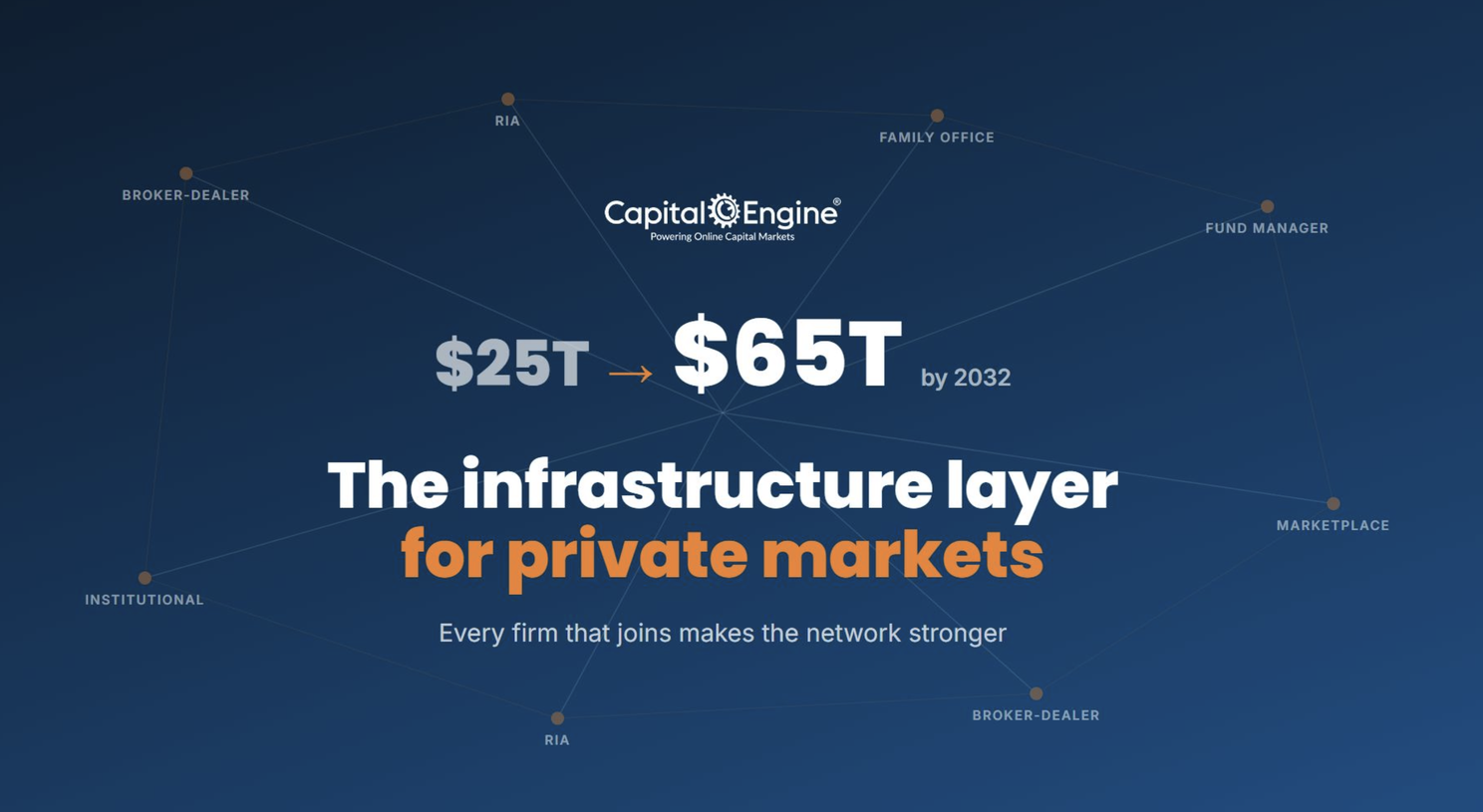
Capital Engine® is building the infrastructure layer for private markets, connecting issuers, broker-dealers, RIAs, family offices, and institutional investors through a single digital ecosystem.
Our infrastructure supports:
- Digital capital formation
- Investor onboarding
- KYC/AML and compliance workflows
- Reg D, Reg A+, and Reg S offerings
- White-label investment marketplaces
- Co-syndication and distribution
- AI-enhanced investor matching
- Investor management and reporting
- Tokenization and secondary-market infrastructure
Backed by our FINRA-approved acquisition of Mallory Capital Group ($10B+ raised), and Glynn Capital Advisors (RIA) Randy Humphreys joining our firm, we’re building regulated connections between private-market opportunities and the investors and intermediaries who evaluate them.
As access moves to the phone, the layer behind it matters more: the compliance, onboarding, and records that make a tap defensible.
Private Markets Go Mobile
Public markets were transformed when trading moved into everyone’s pocket.
Private markets may follow, built around:
- Mobile discovery and onboarding
- Regulated, advisor-ready vehicles
- Clear disclosure of liquidity limits
- AI-assisted education with guardrails
- Daily or more frequent valuations
- Tokenized recordkeeping and settlement
A smartphone won’t remove the risks of illiquid investing, and it won’t replace due diligence or suitability.
But it can put the right information in front of more investors, sooner.
The opportunity isn’t simply to put private markets on a phone. It’s to build the infrastructure that makes them worth carrying.
Capital Engine® is the infrastructure layer for private markets. We connect issuers, broker-dealers, RIAs, family offices, and institutional investors through a unified digital syndication and distribution network ecosystem.
Watch a 3-minute walkthrough of how our broker-dealer, RIA and family office co-syndication network works: https://youtu.be/VvlQ_e1yeXI
EXPLORE PRIVATE MARKET INVESTMENTS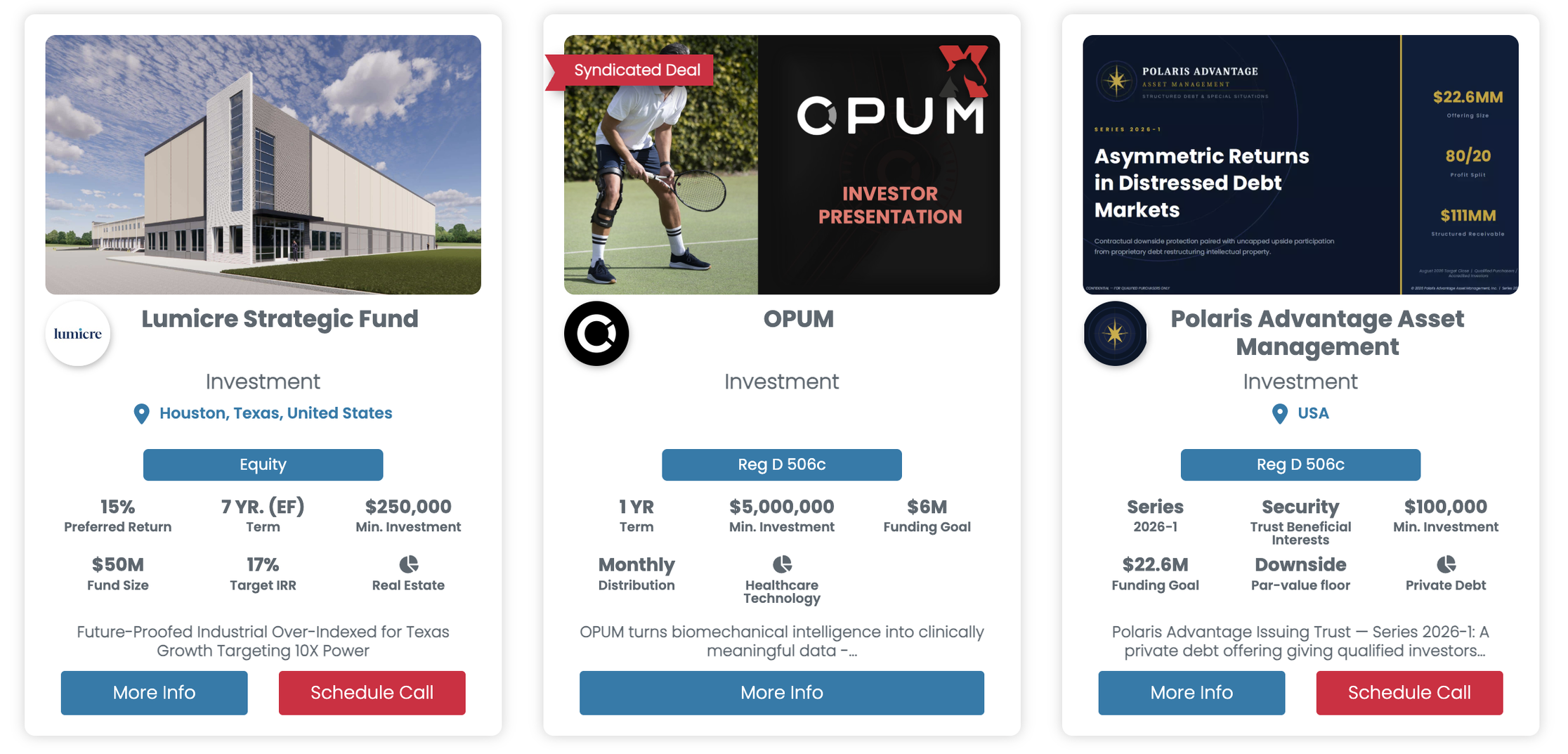
Private Markets This Month
Launch of StreetZero.com the AI Engine for Private Markets Intelligence. StreetZero tracks venture and private-placement deals — with AI analysis, source documents, and the proprietary StreetZero Signal REGISTER NOW
Clearlake Capital Launches Clearlake Private Wealth and Announces Upcoming Interval Fund Clearlake plans an interval fund for private wealth investors, expected in Q1 2027, focused on secondaries and co-investments, with registration not yet effective. READ MORE
Kroll: Retail Investors in Private Markets, Reporting Quarterly in Arrears Is No Longer Sufficient A panel recap argues more frequent valuations do not make private assets more liquid, and that investor education must keep pace. READ MORE
Moonfare Investor Survey 2026 63% of surveyed private wealth investors plan new allocations in 2027, up from 55%, even as two-thirds cite exit concerns. READ MORE
Morgan Stanley Tokenizes US Stocks and Treasuries Through DTCC Blockhead reports Morgan Stanley is among the first banks to use DTCC’s tokenization service, while its own tokenized-equity venue slips to Q1 2027. READ MORE
Video: Broker-Dealer / RIA Co-syndication & Distribution Network
Up Next: The Rise of Always-On Capital Markets How continuous fundraising and secondary liquidity are replacing traditional capital cycles. If you missed any of the earlier issues, you can catch up at: Capitalengine.io/newsletter
Interested in learning more about Capital Engine® - Request a Demo
Subscribe on LinkedIn to the Private Capital Pulse newsletter to stay ahead of the curve in the evolving world of private investments.
T&C* Apply. Read our terms & privacy policy.