

How continuous fundraising and secondary liquidity are replacing traditional capital cycles.
For decades, private markets ran on a calendar.
Raise a fund. Deploy it. Wait. Exit. Raise the next one.
That rhythm shaped everything, from how managers raised capital to when investors could get their money back.
It is starting to break down.
But the next phase may look very different from the last.
Funds are raising continuously.
Secondaries are becoming a standing market.
Private companies are scheduling their own liquidity.
Public markets are moving toward nearly 24-hour trading.
And investors expect access on their own timetable.
Welcome to The Rise of Always-On Capital Markets.
From Vintage Years to Evergreen
The traditional model was episodic. Capital arrived in waves, roughly every few years, and left when assets were sold.
That model is under strain. According to Deloitte’s 2027 Private Capital Outlook, published November 12, private capital fundraising peaked at nearly $1.91 trillion in 2021 and fell for four straight years to about $1.47 trillion in 2025.
At the same time, evergreen structures are gaining ground. Deloitte, citing S&P Global, notes that 123 new evergreen private-market funds launched in 2025, the most in a decade.
The question is no longer whether capital can be raised continuously. The question is whether the infrastructure behind it can keep pace.
Secondaries Become a Standing Market
If continuous fundraising is the front door, secondaries are increasingly the back door.
Deloitte reports that global secondary volume exceeded $120 billion in the first half of 2026, including $65 billion of GP-led and $56 billion of LP-led transactions.
Deloitte says these tools may become part of regular portfolio planning as traditional exits reopen unevenly.
What began as a way to tidy up portfolios is turning into an always-available exit route, though one that may come at a price below reported NAV.
The Liquidity Promise Meets Its First Real Test
Semi-liquid funds offer periodic liquidity, not instant liquidity. This quarter showed the difference.
According to FinancialMarkets.com, citing an SEC filing, Partners Group’s flagship U.S. evergreen fund received about $2.21 billion of redemption requests, roughly 15% of net assets, and accepted $728.4 million, its 5% cap.
In private credit, Stanger reported on November 6 that requests at non-listed BDCs eased to 11.5% of NAV in the third quarter, with sponsors meeting 40% and an estimated $8.2 billion left unmet. Fundraising fell to $1.5 billion, down 87% year over year.
The structures worked as designed.
The lesson is that “always-on” access still runs on rationed exits.
Redesigning the Wrapper
Managers and regulators are responding by redesigning the vehicle itself.
Partners Group is proposing to split its €6.6 billion Global Value Fund into a compounding sleeve of newer vintages, about 23% of the fund, and a distributing sleeve that returns capital as exits come through, Capital Brief reported November 16.
In Washington, the SEC’s interval fund modernization proposal would permit monthly repurchase intervals, giving funds more room to match liquidity to their assets. Comments are due December 4.
The direction is toward more frequent, but more honest, liquidity.
Private Companies Schedule Their Own Liquidity
Liquidity is not only a fund question.
On November 9, Morgan Stanley agreed to acquire Vinyl Equity, a digital-first transfer agent, to connect cap-table management, equity administration, share transfer, and wealth management across private and public markets. Morgan Stanley at Work covers over 70% of the top 100 unicorns, the firm said.
In the U.K., Altilium announced an employee secondary sale through Crowdcube on November 12. Crowdcube says it has generated over £110 million acting on both sides of London Stock Exchange Private Securities Market transactions.
Liquidity events are becoming recurring programs, not one-time exits.
Public Markets Set the Clock
Investor expectations are being shaped by public markets.
Nasdaq is scheduled to begin trading U.S. equities 23 hours a day, five days a week, on December 6, from Sunday evening through Friday evening.
The back end is moving too. On November 12, DTCC said its Tokenization Service, launched October 28, plans to connect to Solana, with DTC-tokenized assets expected there in the second half of 2027.
Private markets won’t trade at 2 a.m. anytime soon. But the investors they are courting increasingly expect markets that don’t close.
The Bottleneck Is Operational
The barrier to always-on private markets may be less about appetite and more about plumbing.
New research from Private Markets and Monark, based on 39 interviews, describes an advisor who needed 900 documents to put six evergreen funds in front of 150 clients. Redemptions can take up to 60 days to settle. One participant said alts are 10% of client portfolios but take 50% to 60% of advisors’ time.
AI may help. Morgan Stanley’s Jed Finn said at the BMO conference that agents are “pretty good at running Monte Carlo simulations,” but “you can’t prompt access to private shares.”
Continuous Raise → Onboarding → Subscription → Valuation → Recordkeeping → Redemption → Secondary Liquidity → Reinvestment
As private markets move from approximately $25 trillion toward a projected $65 trillion by 2032, every manual handoff in that chain becomes harder to sustain.
Capital Engine®: Building the Liquidity Layer
Capital Engine® is building the infrastructure layer for private markets, connecting issuers, broker-dealers, RIAs, family offices, and institutional investors through a single digital ecosystem.
Our infrastructure supports:
- Digital capital formation
- Investor onboarding
- KYC/AML and compliance workflows
- Reg D, Reg A+, and Reg S offerings
- White-label investment marketplaces
- Co-syndication and distribution
- AI-enhanced investor matching
- Investor management and reporting
- Tokenization and secondary-market infrastructure
Backed by our FINRA-approved acquisition of Mallory Capital Group ($10B+ raised), Glynn Capital Advisors (RIA) Randy Humphreys joining our firm, we’re building regulated connections between private-market opportunities and the investors and intermediaries who evaluate them.
In an always-on market, capital formation and liquidity can no longer live in separate systems. We’re building the layer that connects them.
The Rise of Always-On Capital Markets
The old cycle isn’t disappearing overnight. Drawdown funds, long holds, and patient capital will remain central to private markets.
But a new operating model is emerging, built around:
- Continuous fundraising through evergreen and interval structures
- Secondaries as a standing source of liquidity
- Recurring liquidity programs for private companies
- More frequent valuations and clearer redemption terms
- Digital recordkeeping and tokenized settlement
- AI-assisted workflows for advisors
None of this makes illiquid assets liquid. Redemptions remain subject to fund terms, caps, and market conditions.
But it can make liquidity more predictable, more transparent, and better engineered.
The opportunity isn’t simply to keep markets open longer. It’s to build the infrastructure that keeps capital moving.
Capital Engine® is the infrastructure layer for private markets. We connect issuers, broker-dealers, RIAs, family offices, and institutional investors through a unified digital syndication and distribution network ecosystem.
Watch a 3-minute walkthrough of how our broker-dealer, RIA and family office co-syndication network works: https://youtu.be/VvlQ_e1yeXI
EXPLORE PRIVATE MARKET INVESTMENTS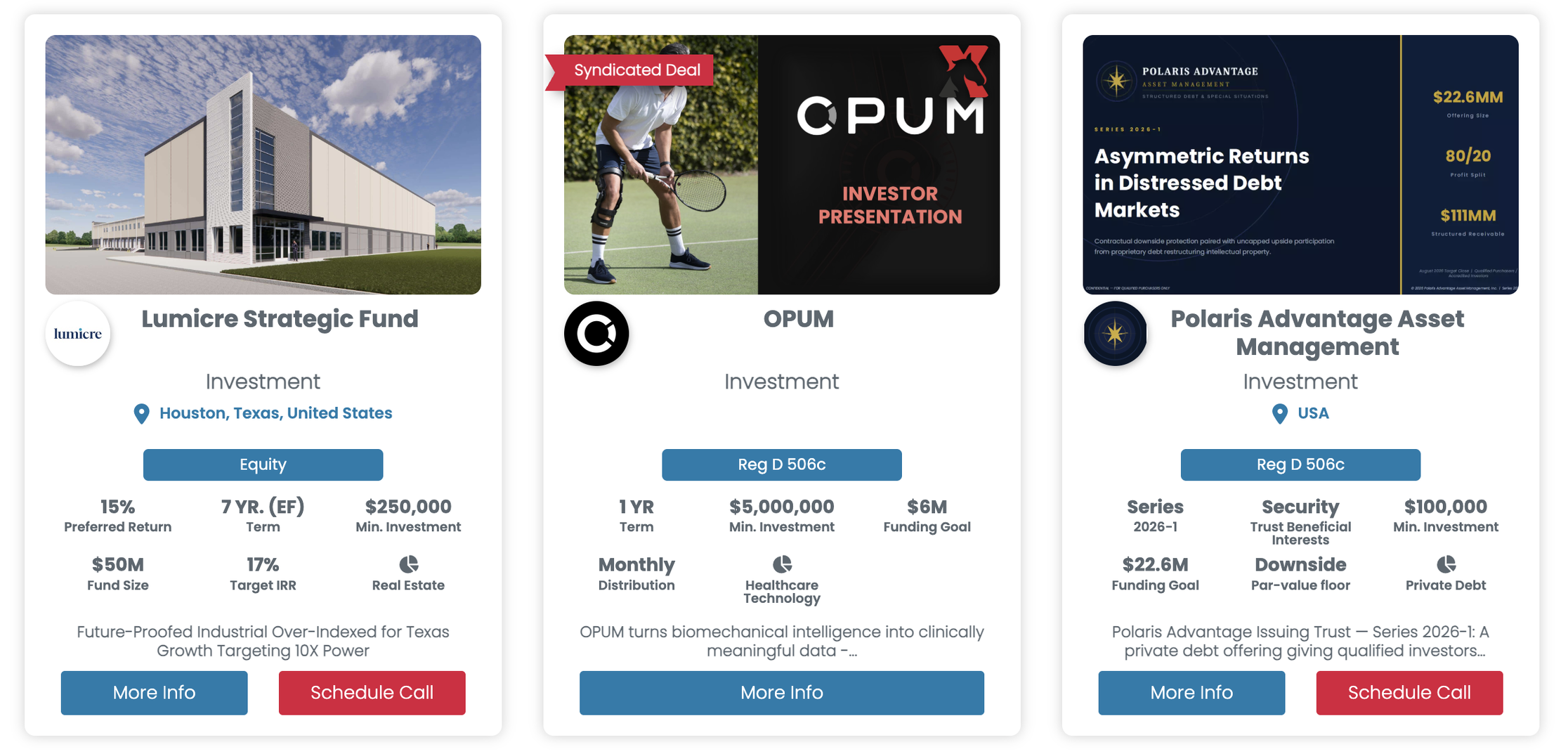
Private Markets This Month
Deloitte: 2027 Private Capital Outlook Deloitte expects closer investor scrutiny of fundraising, with secondaries, continuation vehicles, and evergreen structures playing a bigger role in liquidity. READ MORE
Morgan Stanley to Acquire Digital-Native Transfer Agent Vinyl Equity The deal links cap tables, equity administration, share transfer, and wealth management to support private-to-public transitions and liquidity events. READ MORE
The Evergreen Fund Boom Still Runs on Paperwork New research from Private Markets and Monark finds that holding, redeeming, and rebalancing evergreen funds is still largely manual. READ MORE
DTCC Tokenization Service to Connect with Solana DTCC plans to make DTC-tokenized assets available on Solana in the second half of 2027, advancing its multi-chain strategy. READ MORE
Launch of StreetZero.com the AI Engine for Private Markets Intelligence. StreetZero tracks venture and private-placement deals — with AI analysis, source documents, and the proprietary StreetZero Signal REGISTER NOW
Video: Broker-Dealer / RIA Co-syndication & Distribution Network

Up Next: The Next Unicorn Opportunity Why private investors are capturing more value before companies ever reach public markets. If you missed any of the earlier issues, you can catch up at: Capitalengine.io/newsletter
Interested in learning more about Capital Engine® - Request a Demo
Subscribe on LinkedIn to the Private Capital Pulse newsletter to stay ahead of the curve in the evolving world of private investments.
T&C* Apply. Read our terms & privacy policy.