

How artificial intelligence is reshaping capital raising and investor matching.
For most of its history, investment banking has been built on two scarce resources.
Relationships. And analyst hours.
Pitchbooks were assembled overnight. Investor lists lived in spreadsheets and memories. Capital was raised one call at a time.
That model is now being rewired.
But the next phase may look very different from the last.
AI is moving from chat windows into deal workflows.
Agents are starting to coordinate work across systems.
Investor matching is becoming a data problem.
And regulators are widening the universe of investors those systems will serve.
Welcome to The AI-Powered Investment Bank.
From Copilots to Coordinated Agents
Wall Street’s first wave of generative AI was about productivity: summaries, emails, first-draft decks.
That wave is now mainstream. Fortune’s 2026 AIQ 75 ranking, published September 29, placed JPMorgan Chase first overall. Bank of America is using AI to help its investment bankers develop pitchbooks. “Pretty much everything we demoed a year ago is now live in a scaled fashion,” its chief technology and information officer, Hari Gopalkrishnan Gopalkrishnan, told Fortune.
The second wave is about orchestration. “We’re evolving toward orchestrated systems where multiple agents work together across workflows and enterprise systems,” said Koren Maranca (Picariello), Morgan Stanley’s head of AI for wealth management.
Hiring data agrees: job postings referencing “agent orchestration” jumped 1,721% this year, according to Draup data reported by CNBC on October 2.
The copilot helped the banker. The agent may increasingly run the workflow.
Capital Raising Gets More Concentrated
That shift arrives at a demanding moment for capital formation.
PitchBook’s Q3 2026 Global PE First Look, as summarized by Foley & Lardner, counts 523 private equity funds closed globally this year, pacing 30.5% below 2025, even as capital raised edged up 3.1% to $368.1 billion.
More capital. Fewer funds.
PitchBook points to fundraising concentrating in fewer, larger vehicles. For emerging managers, independent sponsors, and growth companies, the funnel is narrowing.
When capital concentrates, precision matters more. Knowing which investor is allocating, to what strategy, and at what pace can be the difference between a closed round and a stalled one.
Investor Matching Becomes a Data Problem
In late September, Juniper Square launched Capital Intelligence with Nasdaq eVestment, bringing data on more than 30,000 institutional firms and 70,000 mandates directly into its investor CRM. Its AI engine proposes matches, but, as the company put it, “every match is a suggestion until someone accepts it.”
On October 1, Bloomberg completed its acquisition of Canoe Intelligence, an AI-powered platform that turns unstructured private fund information into structured, portfolio-ready data.
A good match depends on clean, connected data at every step:
Sourcing → Screening → Matching → Outreach → Diligence → Subscription → Reporting
AI can accelerate the match.
Human judgment still closes it.
AI Moves Into Underwriting and Monitoring
AI won’t just help find investors faster. It can help evaluate opportunities faster.
On September 28, Golub Capital, with more than $90 billion of capital under management, announced a $5 million strategic investment in F2, an agentic AI platform for credit workflows. Co-CEO David Golub described the aim as embedding the firm’s “proprietary knowledge, accumulated experience and investment judgment” into the systems that support how it invests.
On October 1, Moody’s Analytics and Allvue launched a private credit model designed to flag early signs of borrower stress, such as covenant waivers and payment-in-kind arrangements. Moody’s projects private credit could approach $4 trillion in assets by 2030.
For investors, that could mean greater transparency. For issuers, potentially faster decisions.
The Agent Era Needs Guardrails
Speed without control is not an advantage in regulated markets.
BCG’s Applied AI Index 2026, released September 30, found corporate AI spending has doubled to 3.3% of revenue. Yet while 42% of companies expect to give AI agents real decision-making authority by 2030, only 5% have the full set of controls in place today.
Regulators are staying technology-neutral. FINRA has said firms are responsible for their communications “regardless of whether they are generated by a human or AI technology,” and has proposed risk-based supervision standards covering AI-generated retail communications.
At Sibos in late September, BNY, BNP Paribas, Deutsche Bank, and Citi described agents in production, with people kept for the decisions that matter.
In an AI-powered investment bank, compliance isn’t a brake. It’s part of the architecture.
Retail Investors Want AI With a Human
On September 30, Charles Schwab announced Charley, a generative AI assistant rolling out to eligible U.S. retail clients beginning in October. In a Schwab survey, 65% of retail investors said AI can either help execute routine tasks or play a meaningful role in investing when paired with human expertise.
That qualifier matters.
The same day, the SEC voted to propose interval fund modernization, expanded performance-based fees for regulated funds, and a rules-based framework for multiple share classes. It also requested comment on new accredited investor pathways, including a FINRA-developed exam and CPA, CFA, and CFP credentials. Comment periods run 60 days after Federal Register publication.
None of this is final. But the investor universe may keep widening.
Every new investor will need suitable matches, at scale.
The $65 Trillion Matching Problem
As private markets move from approximately $25 trillion toward a projected $65 trillion by 2032, the core challenge of investment banking may shift.
Not just finding capital. Matching it.
Thousands of issuers. Millions of potential investors. Broker-dealers, RIAs, family offices, and institutions, each with different mandates and eligibility rules.
AI-enabled infrastructure could help connect them by:
- Profiling issuers and offerings
- Mapping investor mandates and eligibility
- Prioritizing outreach
- Automating diligence materials
- Embedding compliance checks
- Supporting secondary liquidity
As tokenization moves fund interests onto digital rails, matching and settlement could run on the same infrastructure.
The winners may be the firms that turn matching into infrastructure.
Capital Engine®: Building the Intelligence Layer
Capital Engine® is building the infrastructure layer for private markets, connecting issuers, broker-dealers, RIAs, family offices, and institutional investors through a single digital ecosystem.
Our infrastructure supports:
- Digital capital formation
- AI-enhanced investor matching
- Investor onboarding
- KYC / AML and compliance workflows
- Reg D, Reg A+, and Reg S offerings
- Co-syndication and distribution
- Investor management and reporting
- Secondary-market infrastructure
Backed by our FINRA-approved acquisition of Mallory Capital Group ($10B+ raised), Glynn Capital Advisors (RIA) joining our firm, and our strategic alliance with Regiment Securities, we’re combining broker-dealer experience with technology designed to connect private-market opportunities with the right investors.
As AI reshapes investment banking, we’re building the intelligence layer that helps capital find opportunity, compliantly and at scale.
We launched StreetZero.com our AI Engine for Private Markets Intelligence. StreetZero tracks venture and private-placement deals — with AI analysis, source documents, and the proprietary StreetZero Signal.
The AI-Powered Investment Bank
The first generation of investment banking was built on relationships, balance sheets, and analyst hours.
The next may be built around:
- Coordinated AI agents
- Data-driven investor matching
- Continuous diligence and monitoring
- Built-in compliance and governance
- Broader investor eligibility
- Digital distribution at scale
AI won’t replace trust, judgment, or relationships in capital markets. It can extend their reach.
The opportunity isn’t simply to automate the investment bank. It’s to rebuild how capital finds opportunity.
And as private markets move toward $65 trillion, the AI-powered investment bank could become one of the defining engines of that transformation.
EXPLORE PRIVATE MARKET INVESTMENTS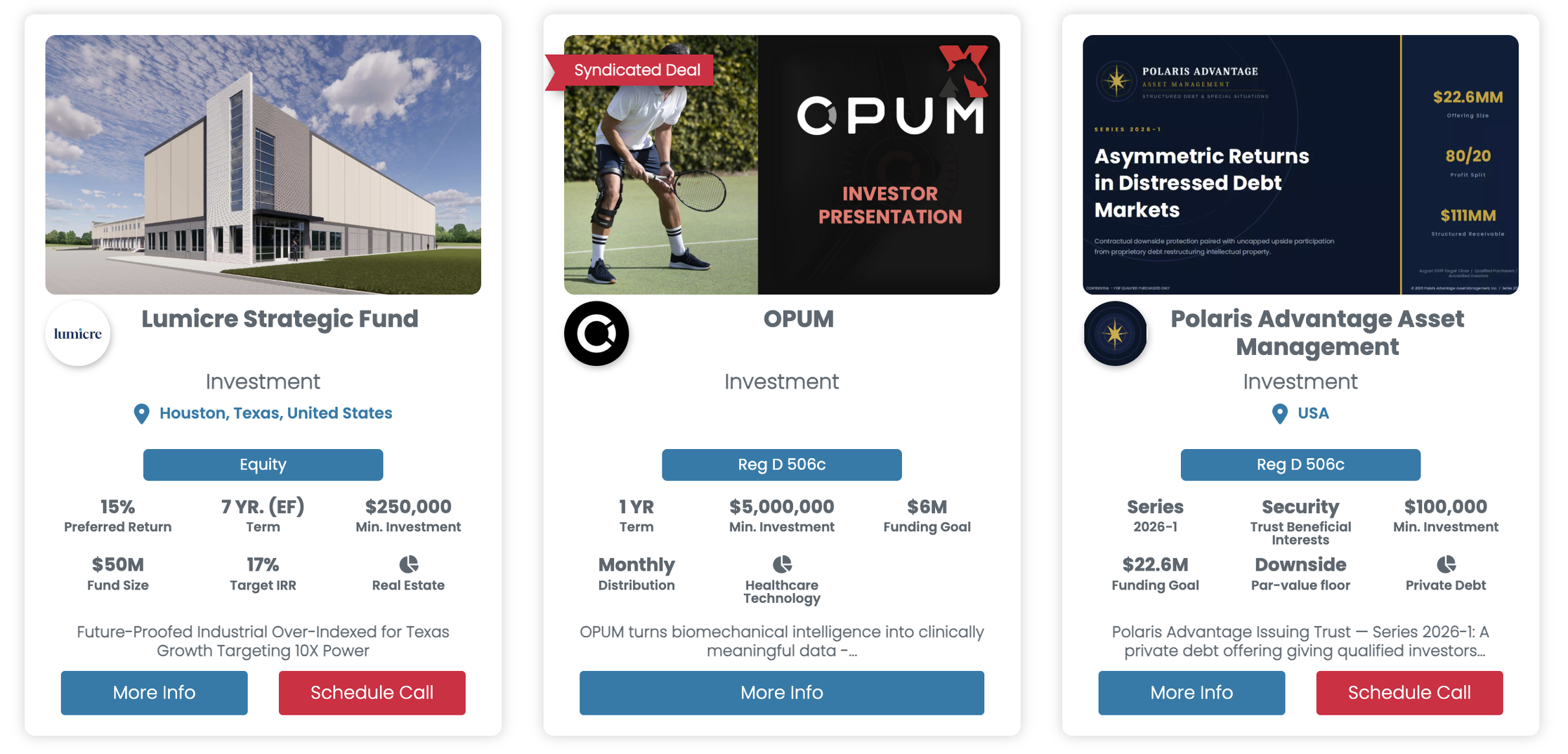
Private Markets This Month
Launch of StreetZero.com the AI Engine for Private Markets Intelligence. StreetZero tracks venture and private-placement deals — with AI analysis, source documents, and the proprietary StreetZero Signal REGISTER NOW
SEC Proposes Amendments to Expand Responsible Retailization of Private Markets The Commission voted to propose performance-fee, interval-fund, and multi-class share changes, and requested comment on exam- and credential-based paths to accredited investor status. READ MORE
Bloomberg Completes Canoe Intelligence Acquisition, Advancing Strategy to Transform Private Markets Investing Bloomberg adds an AI-powered platform that automates private-markets data collection, linking it to portfolio analytics and its agentic AI interface. READ MORE
F2 Announces Strategic Partnership and $5 Million Investment from Golub Capital The $90 billion-plus private credit manager will deploy agentic AI across its investment workflows and chair a new Global Credit AI Council. READ MORE
Moody’s Analytics and Allvue Launch Credit Risk Model to Identify Early Signs of Borrower Stress in Private Credit A model calibrated on observed private credit performance aims to flag stress before it shows up as missed payments. READ MORE
In the Engine Room Podcast

Up Next: Capital Formation Without Borders The globalization of private markets through digital infrastructure. If you missed any of the earlier issues, you can catch up at: Capitalengine.io/newsletter
Interested in learning more about Capital Engine® - Request a Demo
Subscribe on LinkedIn to the Private Capital Pulse newsletter to stay ahead of the curve in the evolving world of private investments.
T&C* Apply. Read our terms & privacy policy.