

Technology is changing how affluent investors manage private market allocations.
For generations, the family office was the most exclusive institution in wealth management.
A dedicated team. Bespoke reporting. Direct deal flow. A seat at the co-investment table.
It was a model built for families with hundreds of millions, or billions, to manage.
That model is now being rebuilt in software.
But the next phase may look very different from the last.
Family offices are investing more like institutions.
AI is moving from pilot projects into daily operations.
Networks are replacing Rolodexes.
And a new generation of affluent investors wants the family office experience without the family office overhead.
Welcome to the Rise of Digital Family Offices.
From Private Office to Platform
Last week, in Beyond Accredited Investors, we looked at how regulation is widening who can invest in private markets, including the credential and registered-fund items on the SEC’s September 30 agenda.
This week, the question is how those allocations are managed.
The traditional single family office was built on people: investment staff, accountants, lawyers, and administrators serving one family across dozens of entities, custodians, and private holdings.
That model delivered control. It also required scale.
Technology is changing the equation. Consolidated reporting, document intelligence, digital subscriptions, and investor portals are turning capabilities that once required a full team into infrastructure that can be shared.
The family office is becoming less of a building and more of a platform.
Family Offices Invest Like Institutions
Citi Wealth’s 2026 Global Family Office Report, released September 22 and based on 351 family offices in 41 countries, shows how central private markets have become.
Private equity funds and direct private equity together account for nearly one-fifth of average allocations. Three-quarters of respondents invest directly in companies, and 40% expect to increase direct investing activity over the next year, versus 8% expecting a decrease.
Interest in secondaries is rising too: 19% expect to increase allocations to secondary strategies, up from 10% in 2025.
Public equities were the top destination for new capital this year, a reminder that allocations move with markets.
But private markets remain, in Citi’s words, “a strategic pillar of family office portfolios.”
The Operating Gap
Investing like an institution requires operating like one.
That is where many family offices struggle. In BlackRock’s 2025 Global Family Office Survey, 75% of respondents reported gaps in internal expertise around private-market analytics, 63% around deal sourcing, and 57% around reporting.
The data problem is just as real. Simple’s 2025 Family Office Software & Technology Report identified data integration as both the most requested capability and the most common point of failure among family offices, as cited in a recent Masttro announcement.
Private holdings arrive as PDFs, capital calls, tax documents, and quarterly letters, spread across entities and advisors.
Every direct deal and co-investment adds another layer of complexity.
AI Moves Into the Back Office
Artificial intelligence is starting to close part of that gap.
According to Citi, 40% of family offices describe themselves as in early AI adoption, 30% in moderate adoption, and 12% as advanced or transformational. Last year, more than half reported no usage at all.
The priorities are telling. The most common applications are meeting summaries, document management, and research assistance. Only 4% use AI extensively for alpha generation.
AI won’t replace judgment in private markets. Citi found families are “ensuring final decisions are still made by experienced humans.”
But AI can turn unstructured documents into structured data, and structured data into faster, better-informed decisions.
For private-market portfolios, that may matter more than any single model.
Connectivity Becomes the Competitive Edge
Citi’s report makes a striking point: “Connectivity has emerged as a competitive advantage.”
The deal-flow data shows why. Nearly 69% of family offices cite their in-house team as a primary source of direct deals, but 49% also cite other families or family offices.
Private-market access is still relationship-driven.
What is changing is how those relationships are organized. Digital platforms can connect families with sponsors, co-investors, and each other, while handling the workflow behind every deal:
Sourcing → Diligence → Co-Investment → Subscription → Capital Calls → Reporting → Liquidity
The next family office advantage may not be a bigger team.
It may be a better network.
The Family Office Goes Multi-Family
Consolidation is accelerating the shift.
On September 23, Corient announced the acquisition of FortCay Family Advisory, a Cayman Islands multi-family office overseeing about $2.6 billion for 14 ultra-high-net-worth families, InvestmentNews reported. Days earlier, the parent of Forbes Family Trust agreed to acquire alternatives manager Optima Fund Management to deepen its manager access.
The logic is consistent: shared platforms, shared technology, shared access.
Services once reserved for a single family are increasingly delivered at scale.
As private markets move from approximately $25 trillion toward a projected $65 trillion by 2032, the infrastructure serving family capital will need to scale with them.
The Affluent Want the Family Office Experience
The biggest shift may be further down the wealth spectrum.
FTSE Russell’s 2026 wealth pulse survey of affluent U.S. investors found that 32% already hold private-market investments, rising to 67% among affluent Millennials. And 77% of those investors access the asset class through a financial advisor.
These investors don’t need a dedicated office. They want what one provides: consolidated visibility, curated access, tax and estate coordination, and a clear view of private holdings alongside public ones.
Wealth-tech firms are building for exactly that. Luminary, which announced its Series A this month, said it started “to democratize the kind of advice and service previously accessible only to a select few, family-office clients.”
Call it the family office, unbundled.
Capital Engine®: Building the Co-Investment Layer
Capital Engine® is building the infrastructure layer for private markets, connecting issuers, broker-dealers, RIAs, family offices, and institutional investors through a single digital ecosystem.
Our infrastructure supports:
- Digital capital formation
- Investor onboarding
- KYC / AML and compliance workflows
- Reg D, Reg A+, and Reg S offerings
- White-label investment marketplaces
- Co-syndication and distribution
- Investor management and reporting
- Secondary-market infrastructure
Backed by our FINRA-approved acquisition of Mallory Capital Group ($10B+ raised), Glynn Capital Advisors (RIA) joining our firm, we’re scaling a network designed to connect private-market opportunities with family offices, advisors, and a broader universe of investors.
As family offices evolve from standalone investors into connected networks, we’re building the layer that helps them source, share, and manage private-market opportunities together.
The Rise of Digital Family Offices
The first generation of family offices was built around people and proximity.
The next may be built around:
- Institutional-style private-market allocations
- AI-assisted operations and reporting
- Digital co-investment networks
- Shared multi-family platforms
- Family office services for the affluent
None of this replaces trust, judgment, or relationships. It extends them.
The opportunity isn’t simply to digitize the family office. It’s to make its capabilities available to far more investors.
And as private markets move toward $65 trillion, digital family offices could become one of the most important channels connecting private wealth with private markets.
EXPLORE PRIVATE MARKET INVESTMENTS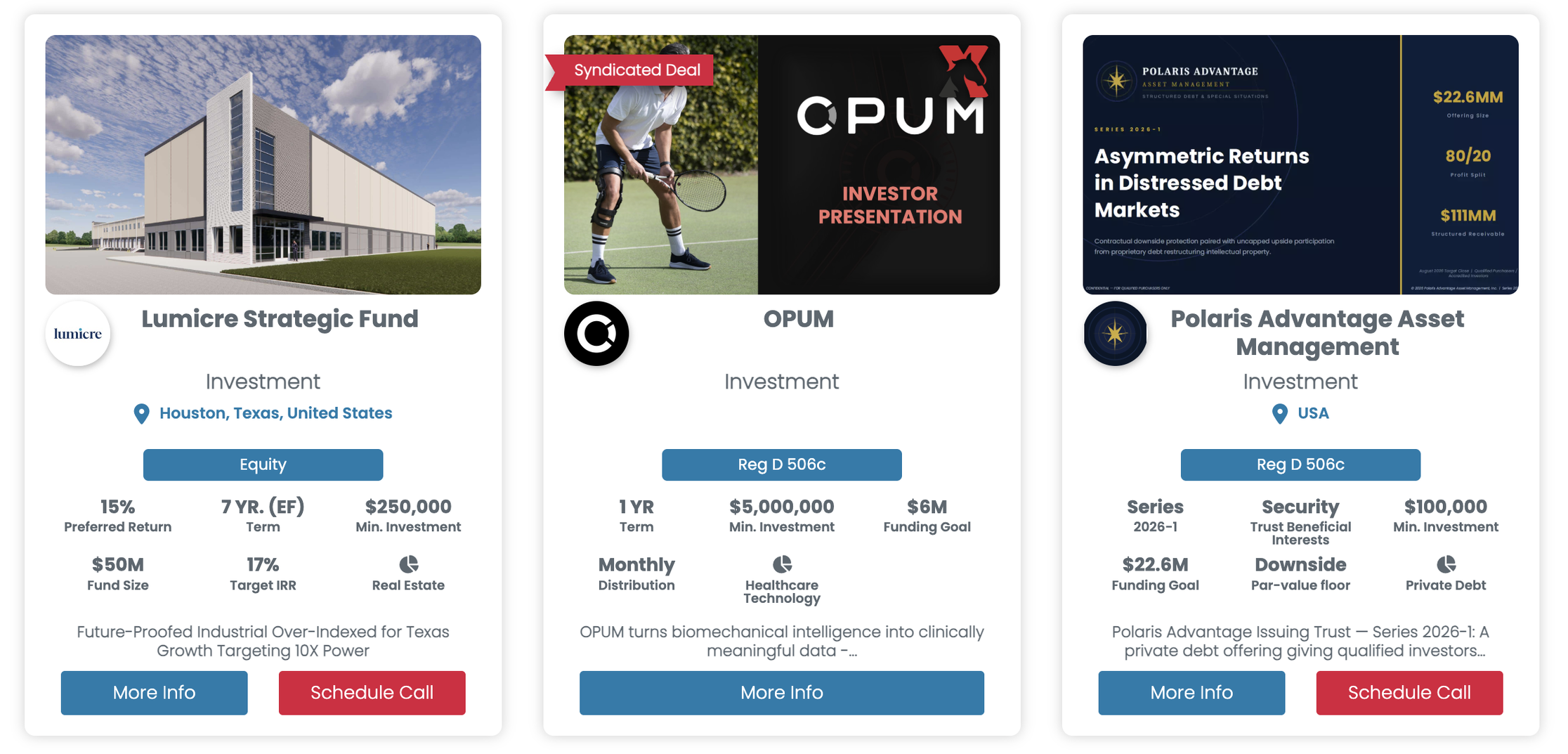
Private Markets This Month
Launch of StreetZero.com the AI Engine for Private Markets Intelligence. StreetZero tracks venture and private-placement deals — with AI analysis, source documents, and the proprietary StreetZero Signal REGISTER NOW
Citi Wealth’s 2026 Global Family Office Report Reveals Clients Are Shifting Their Focus Towards Public Equities A survey of 351 family offices finds private markets still a strategic pillar, direct investing widespread, and AI moving from experimentation to implementation. READ MORE
Corient Enters Cayman Islands with $2.6B FortCay Acquisition The multi-family office consolidator adds a Cayman foothold as cross-border family wealth grows more complex. READ MORE
Private Markets Move Further into the Mainstream: Insights from the 2026 Wealth Pulse Survey FTSE Russell finds nearly a third of affluent U.S. investors hold private markets, led by Millennials and accessed mostly through advisors. READ MORE
Luminary Raises $22 Million to Power the Data Infrastructure Behind Wealth Transfer An AI-native platform turning estate documents into structured data raises its Series A, backed in part by family offices. READ MORE
Luminary Raises $22 Million to Power the Data Infrastructure Behind Wealth Transfer An AI-native platform turning estate documents into structured data raises its Series A, backed in part by family offices. READ MORE
In the Engine Room Podcast

Up Next: The AI-Powered Investment Bank How artificial intelligence is reshaping capital raising and investor matching. If you missed any of the earlier issues, you can catch up at: Capitalengine.io/newsletter
Interested in learning more about Capital Engine® - Request a Demo
Subscribe on LinkedIn to the Private Capital Pulse newsletter to stay ahead of the curve in the evolving world of private investments.
T&C* Apply. Read our terms & privacy policy.